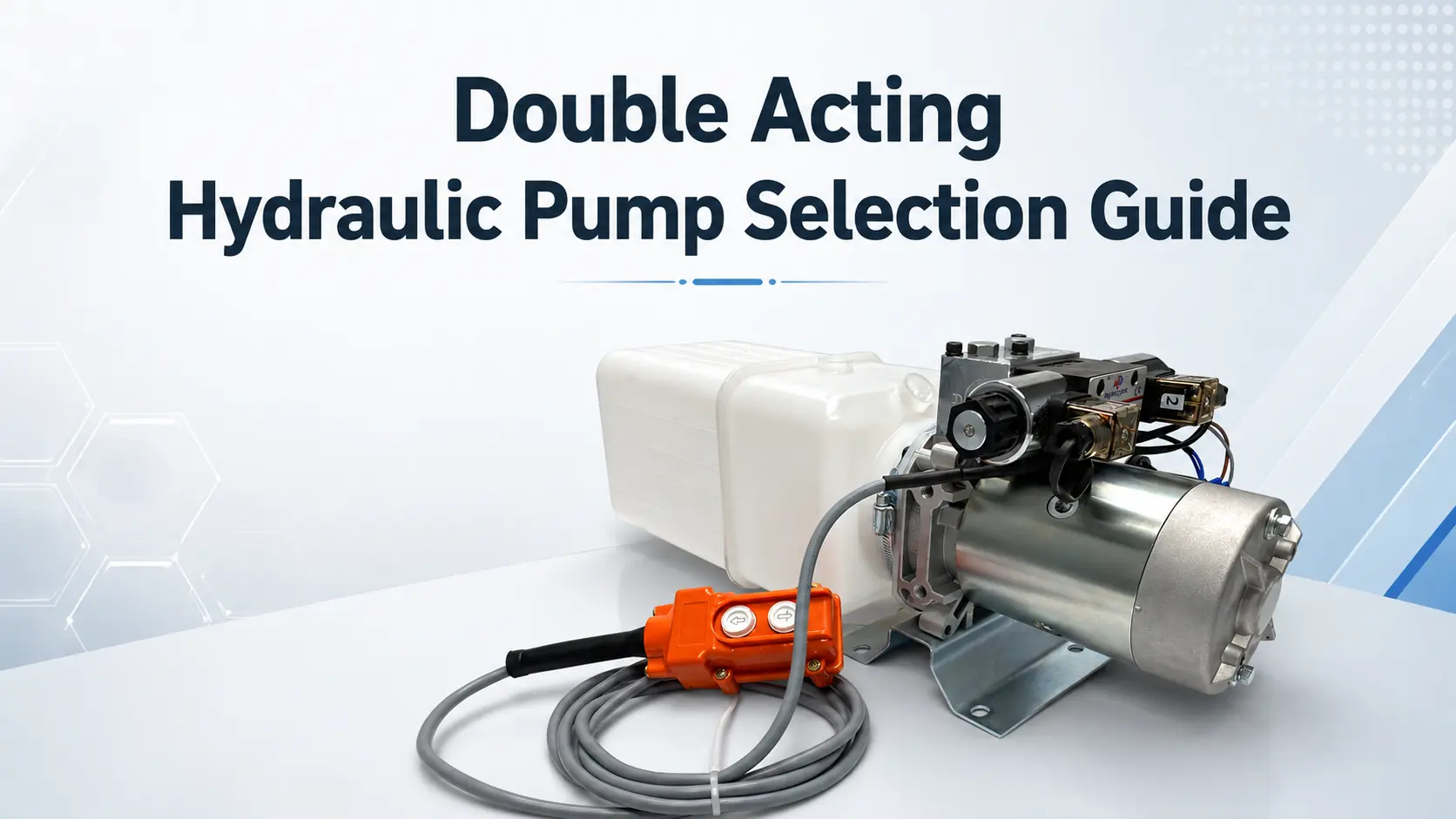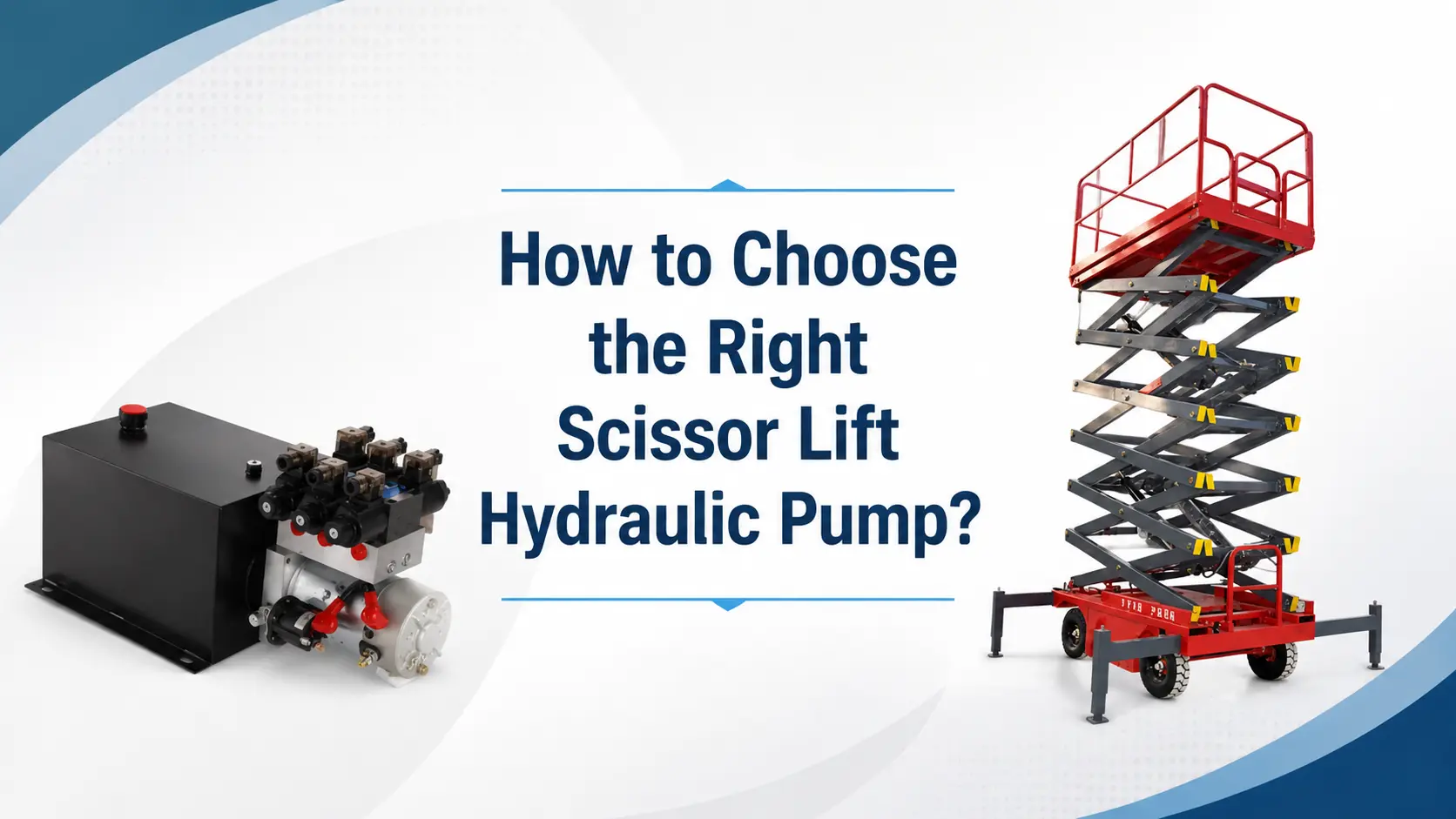
Choose a scissor lift hydraulic pump by matching its flow and pressure to the cylinder size, maximum load, target lift time, power supply, motor duty cycle, hydraulic circuit, reservoir, mounting position, and ports. For most compact scissor lifts, a correctly sized gear-pump power unit provides the best balance of reliability, cost, and straightforward maintenance.
What Does a Scissor Lift Hydraulic Pump Do?
A scissor lift hydraulic pump converts the motor’s mechanical input into hydraulic flow. Resistance to that flow creates pressure; the pressurized oil enters the cylinder and produces the force that opens the scissor mechanism.
The operating sequence is straightforward:
- 1Raising: The motor drives the pump, which draws oil from the reservoir and sends it through the manifold to the cylinder. The cylinder extends and raises the platform.
- 2Holding: When the motor stops, a load-holding or check valve prevents unintended reverse flow. The exact safety circuit depends on the lift design and applicable requirements.
- 3Lowering: A lowering valve opens and lets oil return to the reservoir. Many compact lifts use a “power up, gravity down” circuit, with a flow-control valve regulating descent speed.
Flow primarily affects lift speed, while pressure must be sufficient for the required cylinder force. Increasing a relief-valve setting is not a safe substitute for correct pump, motor, cylinder, and structure sizing.

Which Pump Type Works Best in a Scissor Lift?
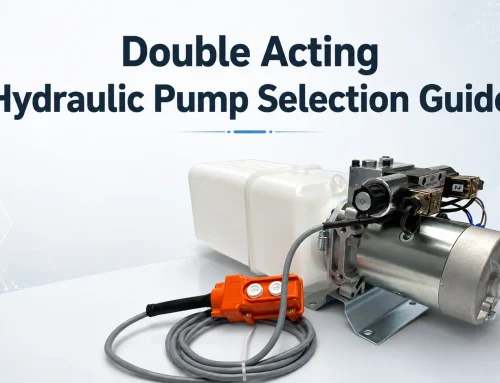
An external gear pump is the usual choice for a compact scissor lift hydraulic power unit because it is simple, durable, economical, and well suited to intermittent lifting duty. Vane and piston pumps can be appropriate when noise, efficiency, pressure, or control requirements justify a more complex design.
| Pump type | Strongest fit | Advantages | Trade-offs |
|---|---|---|---|
| External gear pump | Compact mobile lifts, lift tables, power-up/gravity-down circuits | Cost-effective, robust, compact, easy to integrate | More flow ripple and noise; efficiency falls as wear and leakage increase |
| Vane pump | Indoor equipment where lower noise and smoother flow matter | Quiet operation, low pulsation, good serviceability in suitable circuits | More sensitive to fluid cleanliness and inlet conditions |
| Piston pump | High-pressure, variable-flow, or demanding continuous-duty systems | High pressure capability and strong efficiency at the correct operating point | Higher cost and complexity; often unnecessary for a basic compact lift |
There is no universally “most efficient” choice. A piston pump may offer higher efficiency in demanding high-pressure or variable-displacement service, but a correctly sized gear pump can be the more efficient overall procurement decision for a simple intermittent-duty lift because it reduces cost, complexity, and service burden. When comparing standard and custom configurations, our scissor lift hydraulic pump solutions provide a practical starting point.
What Specifications Are Needed to Select a Scissor Lift Hydraulic Pump?
A reliable scissor lift hydraulic pump recommendation requires only the core machine and operating data:
- 1Maximum load and basic scissor-lift geometry
- 2Cylinder quantity, bore, rod diameter, and stroke
- 3Required lifting and lowering time
- 4AC or DC supply, voltage, and motor duty cycle
- 5Working pressure and flow, if already known
- 6Circuit type, mounting position, available space, and port specifications
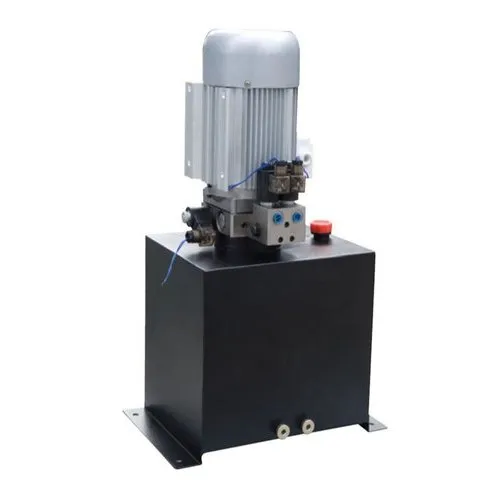
Photos of the existing nameplate, hydraulic schematic, power unit, ports, and mounting points can reduce replacement errors. Submit these core parameters to the Jade Crown Hydraulic team for a matched pump and power-unit recommendation, technical guidance, and quotation.
Should You Choose an AC or DC Hydraulic Power Unit?
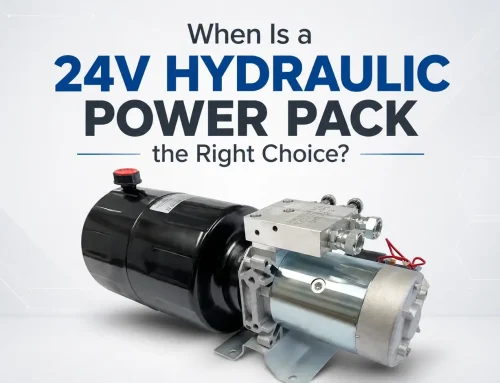
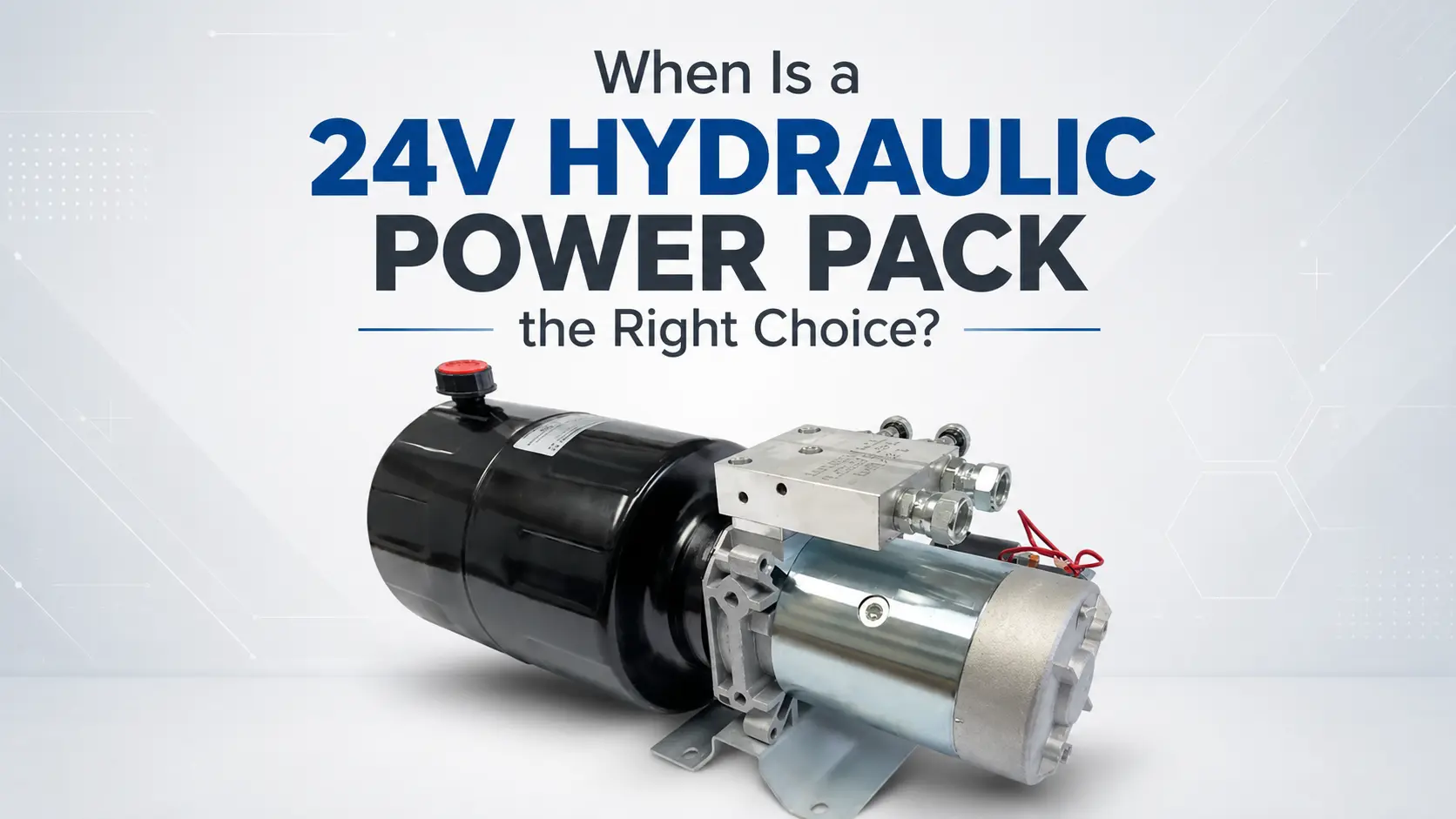
Choose DC when the scissor lift is battery-powered or mobile; choose AC when a stable mains supply is available and the lift is stationary or used in a fixed facility. The final decision must also account for motor power, allowable current draw, duty cycle, charging system, local supply, and required cycle frequency.
| Power source | Typical application | Selection checks |
|---|---|---|
| DC motor | Mobile aerial platforms, carts, battery-powered service lifts | Battery voltage, peak current, cable size, state of charge, intermittent duty |
| AC motor | Stationary lift tables, workshops, production lines | Supply voltage and frequency, phase, motor protection, start frequency, duty |
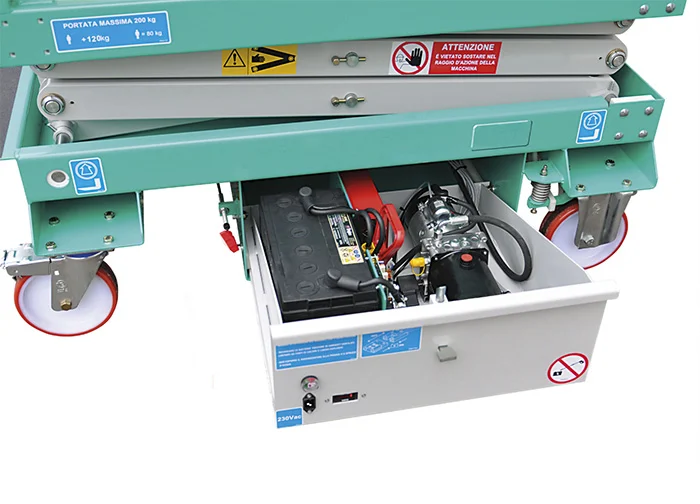
A weak battery or excessive voltage drop can make a healthy pump appear defective. On a DC lift, test voltage at the motor while the lift is commanded upward, not only at rest.
How Do You Match Flow, Pressure, and Motor Power?
Use cylinder geometry and target lift time to establish the required flow, then calculate the pressure needed at the most demanding point in the lift cycle. Scissor mechanisms often require their greatest cylinder force near the fully lowered position, so average-load calculations can undersize the system.
Use these relationships as a first engineering check:
- 1Cylinder force: Force = Pressure × Effective piston area
- 2Cylinder speed: Speed = Flow ÷ Effective piston area
- 3Ideal hydraulic power: Power = Pressure × Flow
Real systems have mechanical, volumetric, and pressure losses, so final motor and pump selection needs an efficiency margin and thermal review. Do not use these simplified equations as the sole basis for certifying a personnel-lifting machine.
Why Source from Jade Crown Hydraulic?
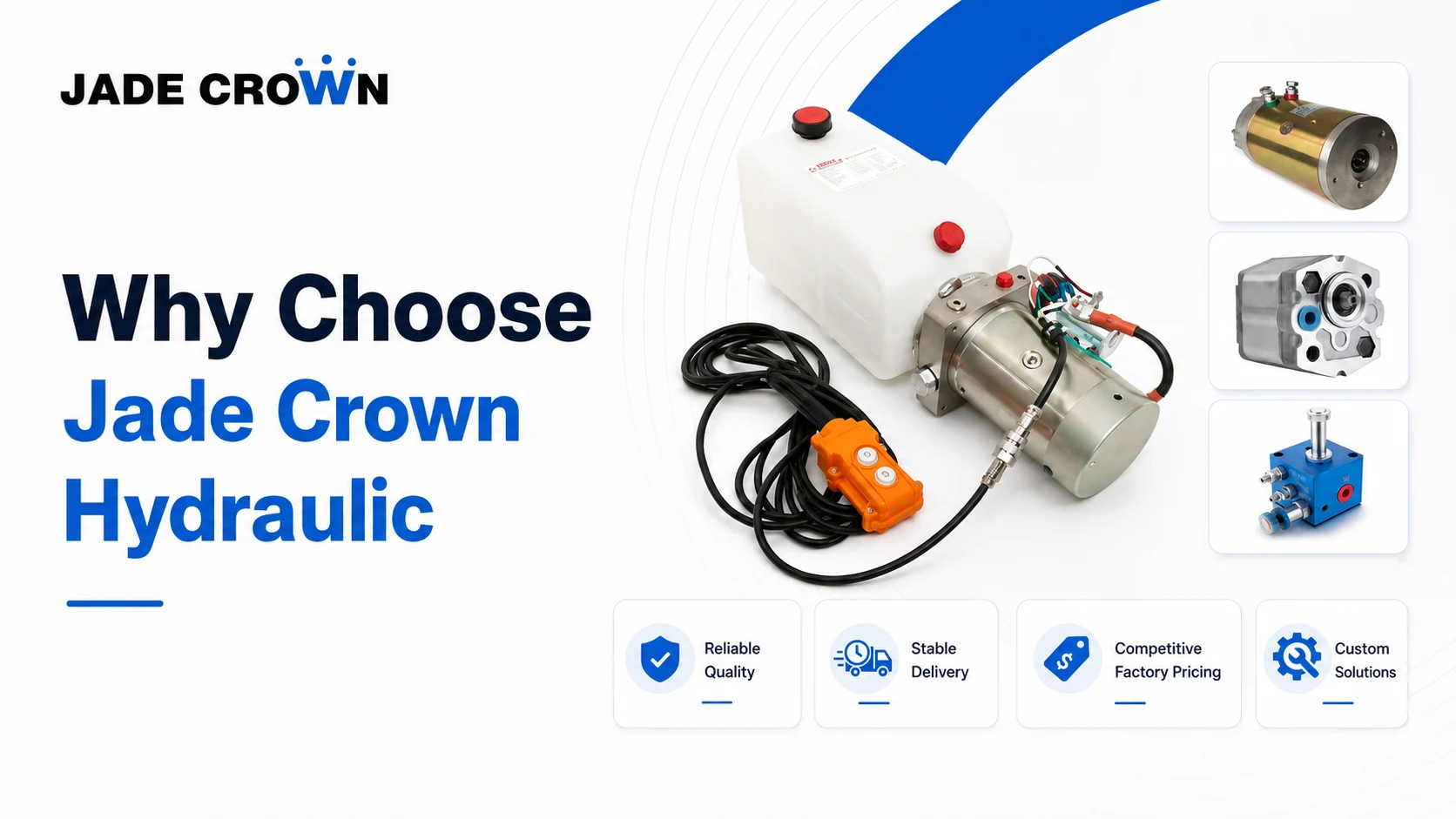
Jade Crown Hydraulic is a professional hydraulic power unit manufacturer that supplies standard and application-specific solutions for scissor lifts.
- 1Professional support for matching the motor, pump, manifold, reservoir, and valve functions
- 2Consistent product quality backed by 100% outgoing functional inspection
- 3One-year warranty under the applicable warranty terms
- 4Competitive factory-direct pricing
- 5Responsive production scheduling and fast delivery
- 6Support for OEM projects and replacement programs
Frequently Asked Questions
Does a scissor lift have hydraulic fluid?
Yes. A hydraulic scissor lift uses manufacturer-specified hydraulic oil to transmit power and lubricate the system.
Why did the hydraulic pump in my scissor lift fail?
Common causes include contaminated or low oil, cavitation, incorrect viscosity, excessive pressure, overheating, and coupling damage. Identify the cause before replacing the pump.
How is a gear pump different from vane and piston pumps?
A gear pump is compact and economical, a vane pump runs more quietly, and a piston pump handles demanding pressure and efficiency requirements at a higher cost.
Which type of scissor lift hydraulic pump is the most efficient?
A piston pump is often the most efficient in demanding high-pressure systems, while a correctly sized gear pump is usually more practical for a compact intermittent-duty scissor lift.
Which pump is used in a hydraulic jack?
Manual hydraulic jacks usually use a plunger pump, while electric scissor lifts commonly use a motor-driven gear pump.
Can I replace only the pump instead of the complete power unit?
Yes, if the replacement pump matches the original specifications and the other power-unit components remain serviceable. Otherwise, replace the complete power unit.