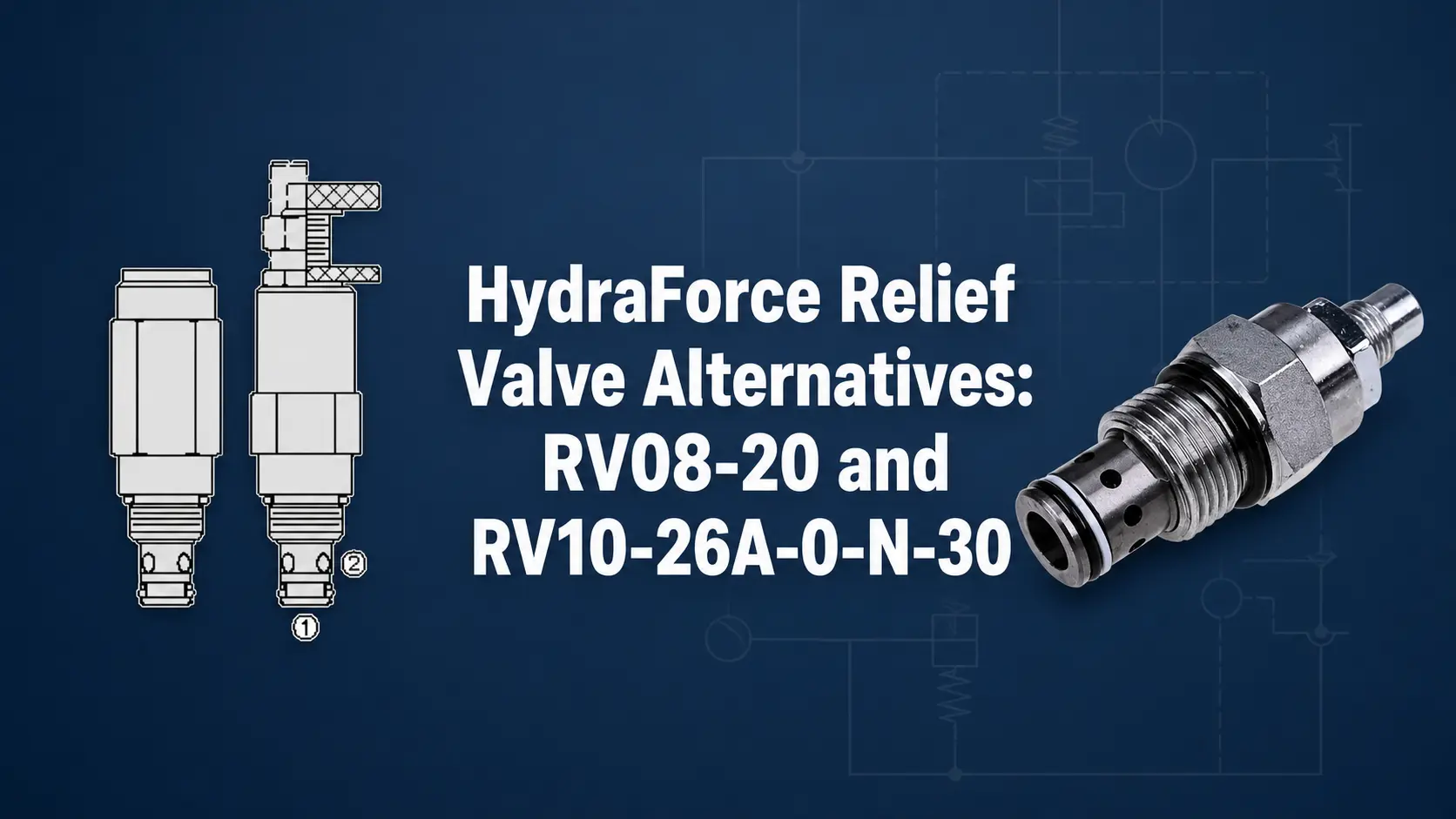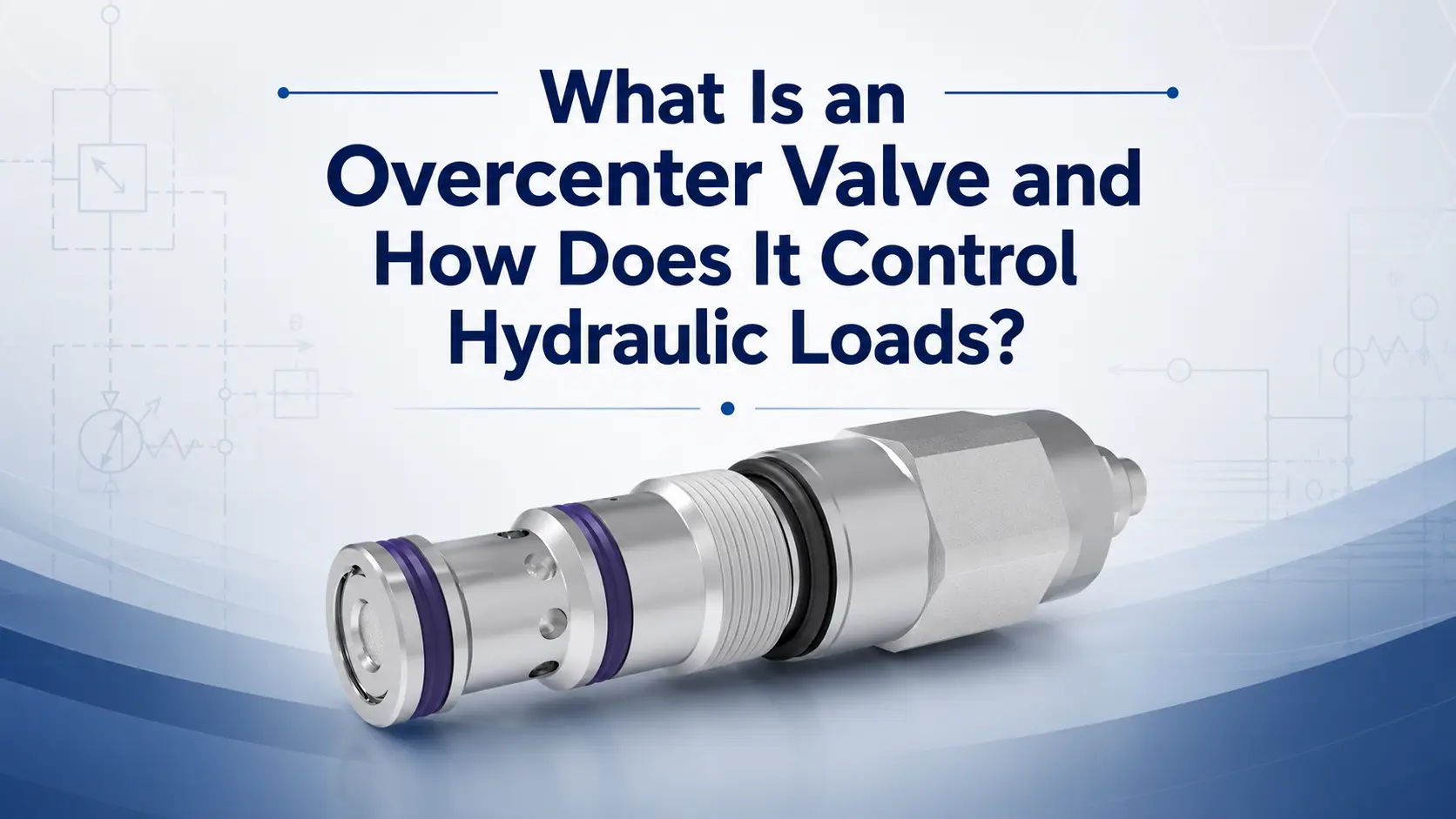
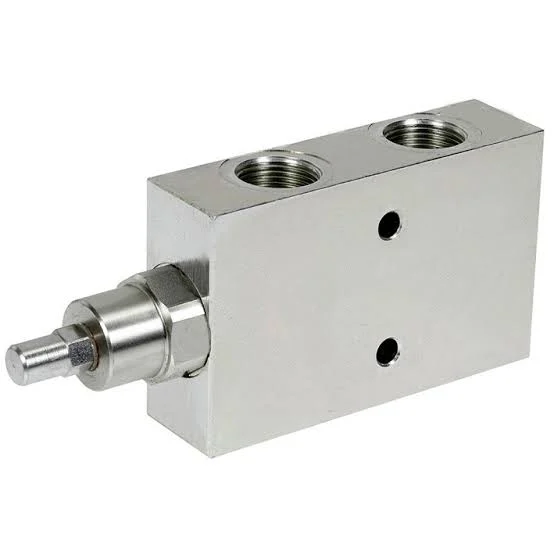
An overcenter valve is a pilot-assisted pressure control valve with an integral free-flow check. It holds a hydraulic load and meters oil leaving an actuator so an overrunning load cannot move faster than the commanded flow. Selection must account for the circuit, load-induced pressure, flow, pilot ratio, back pressure, leakage requirement, mounting method, fluid, and operating conditions.
What Does an Overcenter Valve Do?
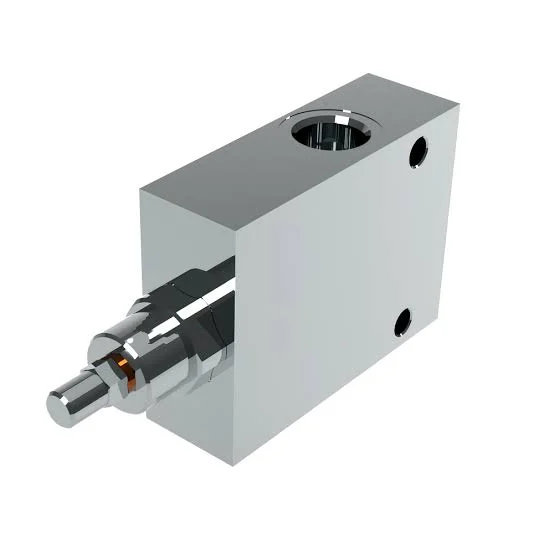
The valve performs three connected functions in a correctly designed circuit:
- 1Load holding: It blocks reverse flow from the actuator when pilot pressure is absent.
- 2Controlled movement: It meters outlet flow while a gravity- or inertia-driven load moves, helping prevent the actuator from running ahead of pump supply.
- 3Pressure protection: Its relief function can limit pressure at the actuator port. When installed on or close to the actuator, it can also help retain the load if an upstream hose fails.
The valve is often called a counterbalance valve, brake valve, or motion-control valve. It is also commonly grouped with load holding valve products, although that category includes other valve types.
How Does It Work in a Hydraulic Cylinder Circuit?
In a typical hydraulic cylinder load holding valve circuit, oil entering the loaded cylinder port flows through the integral check. Oil leaving that port remains blocked until load-induced pressure, pilot pressure from the opposite cylinder line, or both create sufficient opening force.
The valve then opens progressively and meters outlet flow. This maintains back pressure so gravity cannot pull the cylinder ahead of the supplied oil. When the directional valve returns to neutral and pilot pressure disappears, it closes and holds the load-side oil.
Is an Overcenter Valve the Same as a Load Holding Valve?
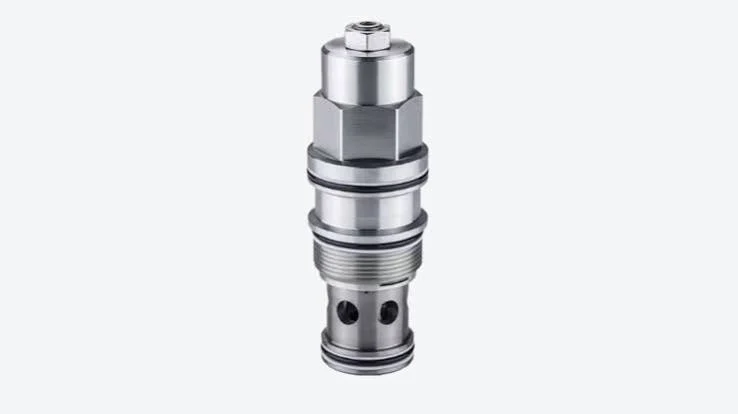
An overcenter valve is one type of load holding valve, but the terms are not always interchangeable. “Load holding valve” describes a function and may refer to an overcenter/counterbalance valve or a pilot-operated check valve.
| Selection question | Overcenter valve | Pilot-operated check valve |
|---|---|---|
| Holds a stationary load | Yes | Yes |
| Meters an overrunning load | Yes; modulates outlet flow | No; normally opens or closes |
| Relief characteristic at load port | Yes, subject to valve and circuit design | Normally no |
| Best starting point | Controlled lowering, overrunning loads, motor braking | Static position locking without motion control |
| Main concern | Stability, setting, pilot ratio, flow and back pressure | Pilot pressure, trapped pressure and release behavior |
A pilot-operated check valve may hold position tightly, but it can cause ratcheting or shock if used to control a gravity-driven load. Where a load must be held and lowered smoothly, an overcenter valve is normally the more suitable starting point, subject to circuit validation.
What Information Is Needed Before Ordering?
To match the valve, provide the core operating data:
- 1Hydraulic schematic and loaded direction
- 2Maximum load and cylinder dimensions, or motor displacement
- 3Working pressure and maximum flow
- 4Cavity or port type, mounting space and order quantity
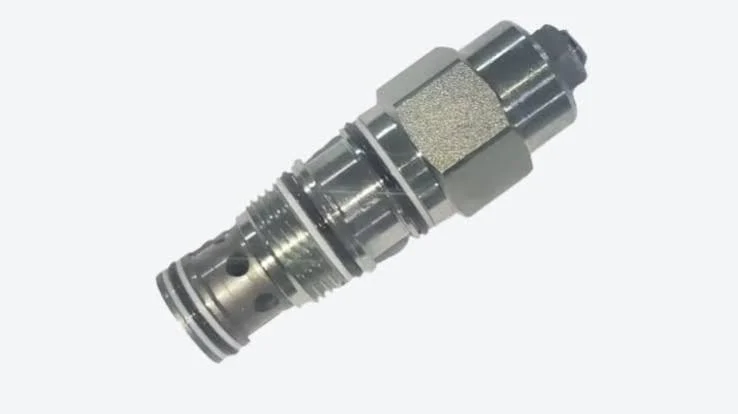
If some values are unknown, send the existing model code and clear photos of the valve, nameplate, ports, and hose routing, then contact our professional team for configuration support.
What Do Pressure Setting and Pilot Ratio Mean?
The pressure setting determines how much load-induced pressure the valve can hold before its relief function begins to open. About 1.3 times the maximum load-induced pressure is a common initial manufacturer guideline for many standard applications, but the final value must be checked against the valve data and complete machine conditions.
The pilot ratio describes how strongly pilot pressure helps open the valve. A lower ratio usually favors stability but needs more pilot pressure; a higher ratio can reduce pressure loss but may be less stable with changing loads. The supplier should confirm the ratio from the schematic, load, pressure, and machine behavior rather than selecting the highest available value.
Where Should the Valve Be Installed?
A hydraulic cylinder load holding valve should normally be installed directly on the cylinder port or as close to the actuator as practical. This location helps retain the load if an upstream hose fails.
Installation must follow the valve’s port diagram and adjustment procedure. The valve does not replace mechanical supports, required safety devices, or the machine risk assessment.
Why Choose Jade Crown Hydraulic?
Jade Crown Hydraulic is a professional hydraulic power unit manufacturer and hydraulic component supplier supporting standard products, OEM programs, cartridge valve manifolds, and application-specific configurations.
- 1Product quality supported by 100% outgoing functional inspection; every completed product is function-tested before shipment
- 2One-year warranty under the applicable warranty terms
- 3Competitive manufacturer pricing for standard, OEM and volume requirements
- 4Responsive production planning and fast delivery based on configuration and quantity
- 5Technical support for circuit, manifold, valve, port and installation matching
To reduce specification and interchange errors before ordering, send the schematic, actuator data, load range, flow, pressure, mounting details, and quantity to the Jade Crown professional team for technical advice.
Frequently Asked Questions
What is an overcenter valve?
It is a pilot-assisted relief valve that holds a hydraulic load and meters oil leaving an actuator.
Is it the same as a counterbalance valve?
Usually yes, but confirm the hydraulic symbol and datasheet because catalog names vary.
How is it different from a pilot-operated check valve?
The former meters an overrunning load and provides relief; a pilot-operated check valve mainly locks or releases flow.
What setting should be used?
About 1.3 times the maximum load-induced pressure is a common starting point, but the final setting depends on the valve and machine.
Does a higher pilot ratio mean better performance?
No; a higher ratio reduces required pilot pressure but may also reduce stability.